

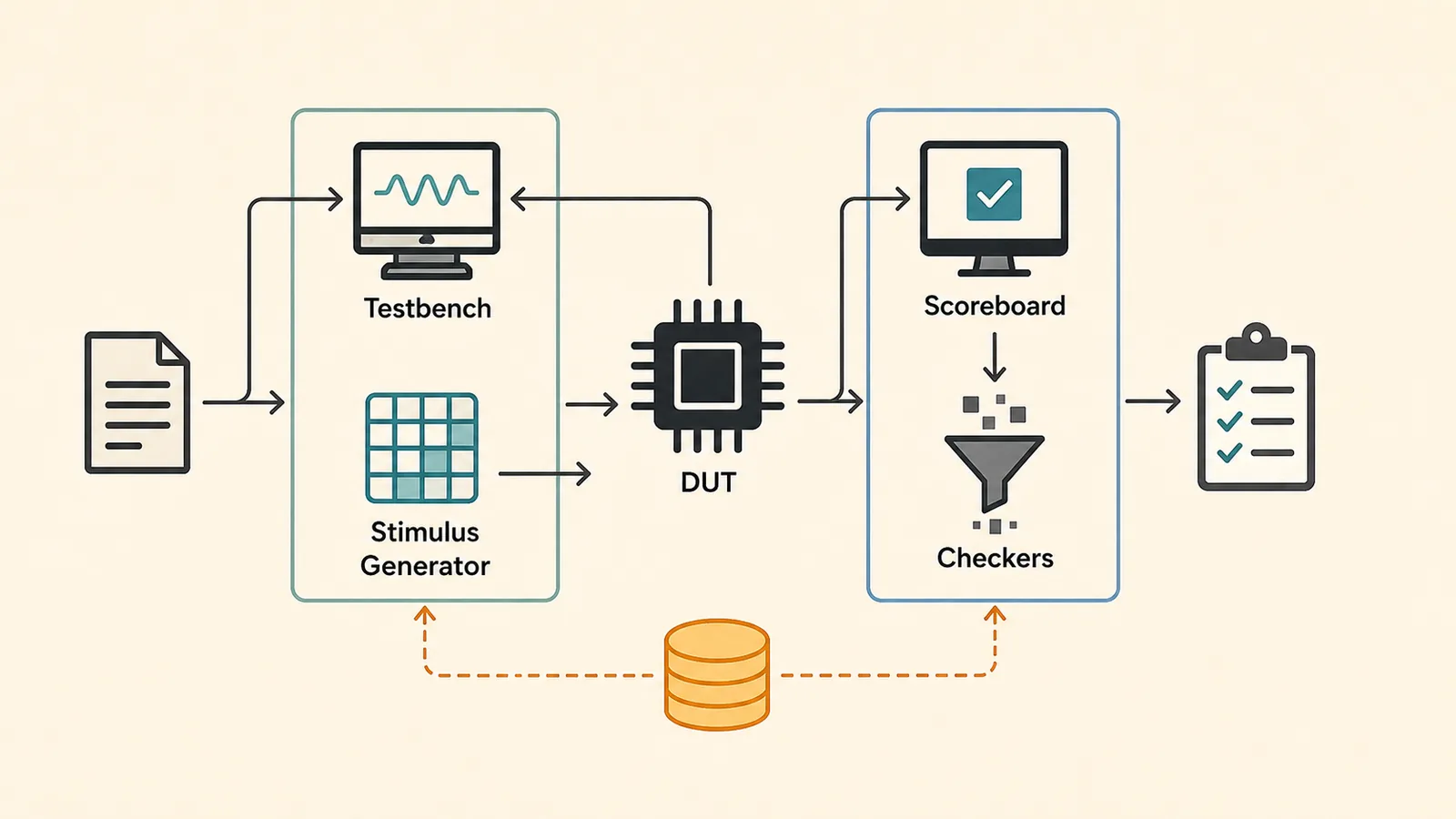

Functional Verification Flow for Complex Digital Designs
Build a scalable verification flow using constrained random stimulus, coverage feedback, assertions, MDV planning, class-based testbenches, and UVM principles to expose hidden bugs, measure progress, automate regression, and improve confidence in complex digital design correctness.
This resource includes
Description
Functional verification for modern digital designs requires more than directed testing and waveform inspection. Large designs contain many legal operating modes, configuration combinations, protocol interactions, and timing-dependent behaviors. Hidden failures often appear only when uncommon but valid conditions occur together. A scalable verification flow must therefore combine structured planning, automated stimulus generation, strong checking, measurable coverage, and reusable testbench architecture. Simulation-based verification provides visibility into design behavior, but simulation volume alone does not define verification quality. Meaningful progress depends on clear verification goals, executable stimulus, observable behavior, and objective metrics. Goal states describe the intended design behaviors that must be reached, including feature activation, boundary values, stress scenarios, protocol sequences, reset behavior, and error handling. These goals guide stimulus creation and coverage modeling, while still recognizing that predefined goals cannot capture every possible corner case. Constrained random verification improves exploration by generating many legal stimulus ...
This resource includes
Description
Functional verification for modern digital designs requires more than directed testing and waveform inspection. Large designs contain many legal operating modes, configuration combinations, protocol interactions, and timing-dependent behaviors. Hidden failures often appear only when uncommon but valid conditions occur together. A scalable verification flow must therefore combine structured planning, automated stimulus generation, strong checking, measurable coverage, and reusable testbench architecture. Simulation-based verification provides visibility into design behavior, but simulation volume alone does not define verification quality. Meaningful progress depends on clear verification goals, executable stimulus, observable behavior, and objective metrics. Goal states describe the intended design behaviors that must be reached, including feature activation, boundary values, stress scenarios, protocol sequences, reset behavior, and error handling. These goals guide stimulus creation and coverage modeling, while still recognizing that predefined goals cannot capture every possible corner case. Constrained random verification improves exploration by generating many legal stimulus ...
Recommended

EDA Academy is a practical learning platform for engineers in the VLSI and semiconductor industry. We offer structured courses, technical resources, and career-focused training across all major areas of chip design and verification — from Verilog to Physical Design, from fundamentals to advanced topics. Learn at your own pace, explore member-exclusive content, or join as an instructor to share your expertise. Lear...
