

Machine Learning Techniques and Model Optimization
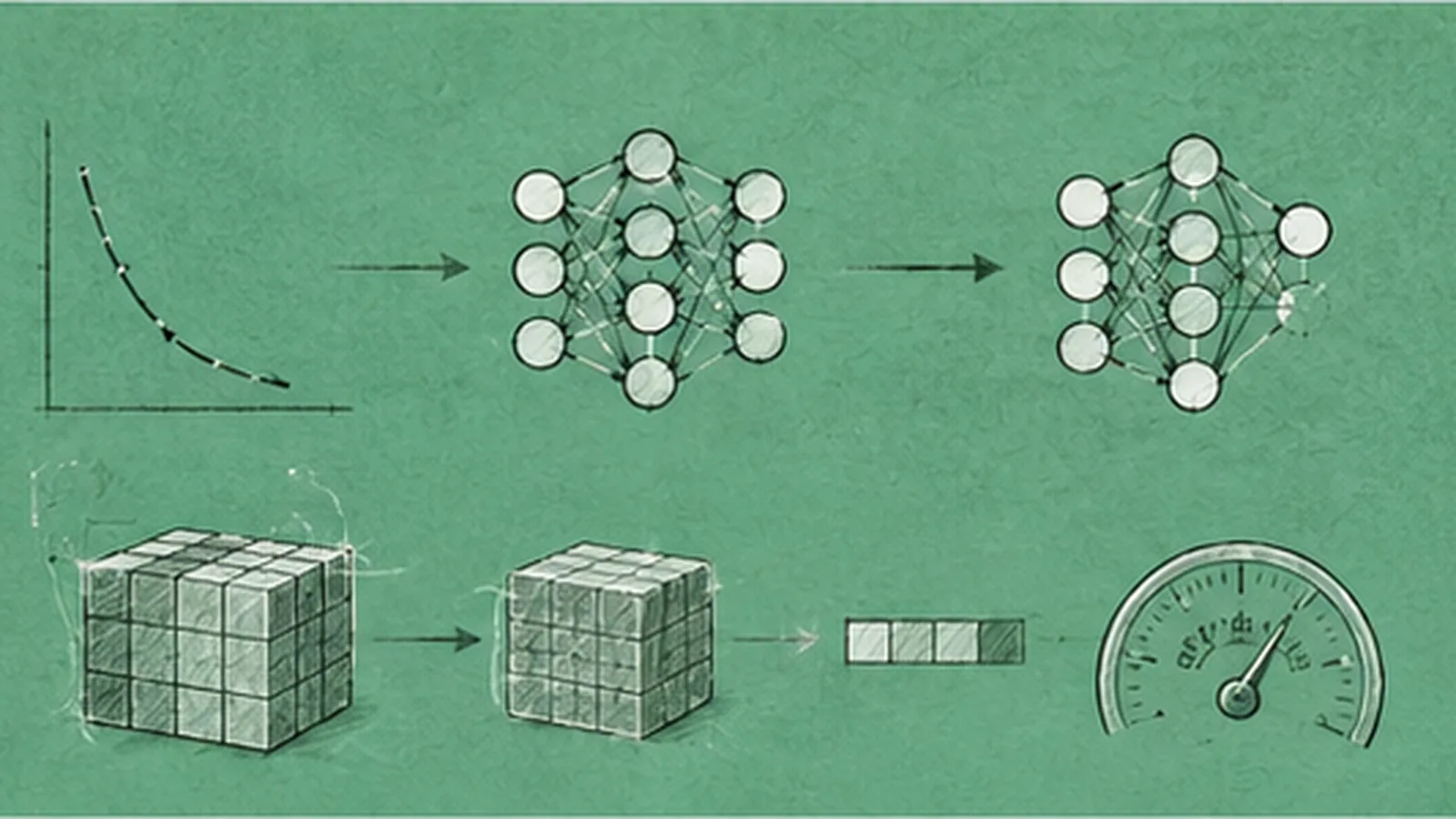
Machine learning techniques connect dataset collection, feature extraction, model selection, neural network training, classification, dimensionality reduction, kernels, regularization, and model compression. The focus is practical model development, from data preparation to efficient edge and on-device AI deployment.
This resource includes
Description
Machine learning model development starts with selecting and preparing the right data. Existing datasets can accelerate development when they match the target problem, while new data collection becomes necessary when the available information is incomplete or not representative. Data gathering methods, sensor sources, live input streams, and domain-specific measurements directly influence model quality. Feature extraction turns raw data into structured inputs that allow a model to connect observable properties with expected output behavior. Model selection depends on the relationship between input features and output results. A model can be treated as a function that maps input data to a prediction, classification, or decision-support result. Simple functions are useful when the data relationship is clear and mostly linear. More advanced models are needed when the data contains nonlinear behavior, high-dimensional feature spaces, or complex class boundaries. Neural networks support this complexity through weighted connections, layers, and activation functions. Training adjusts model weights so that predicted outputs move closer to expected outputs. Linear relationships can be und...
This resource includes
Description
Machine learning model development starts with selecting and preparing the right data. Existing datasets can accelerate development when they match the target problem, while new data collection becomes necessary when the available information is incomplete or not representative. Data gathering methods, sensor sources, live input streams, and domain-specific measurements directly influence model quality. Feature extraction turns raw data into structured inputs that allow a model to connect observable properties with expected output behavior. Model selection depends on the relationship between input features and output results. A model can be treated as a function that maps input data to a prediction, classification, or decision-support result. Simple functions are useful when the data relationship is clear and mostly linear. More advanced models are needed when the data contains nonlinear behavior, high-dimensional feature spaces, or complex class boundaries. Neural networks support this complexity through weighted connections, layers, and activation functions. Training adjusts model weights so that predicted outputs move closer to expected outputs. Linear relationships can be und...
Recommended

EDA Academy is a practical learning platform for engineers in the VLSI and semiconductor industry. We offer structured courses, technical resources, and career-focused training across all major areas of chip design and verification — from Verilog to Physical Design, from fundamentals to advanced topics. Learn at your own pace, explore member-exclusive content, or join as an instructor to share your expertise. Lear...
