

.png&w=3840&q=75)
Power Reduction in CMOS Circuits
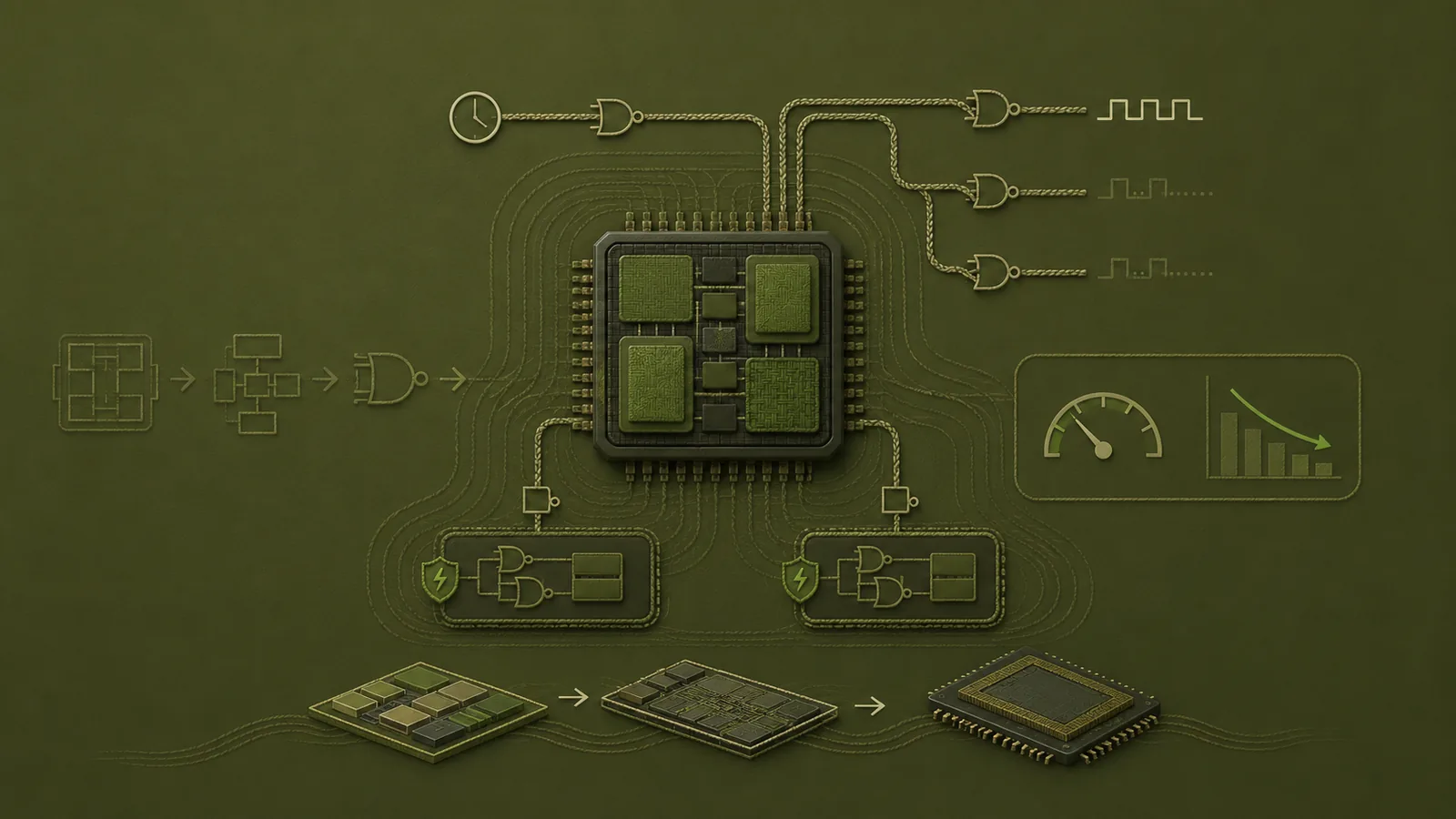
Power reduction in CMOS circuits is a fundamental requirement for modern integrated systems, especially in power-sensitive and thermally constrained environments. Here explores the key sources of power dissipation—dynamic and leakage power—and examines how these challenges evolve with technology scaling. A range of reduction strategies is introduced, including dynamic voltage and frequency scaling (DVFS), operand isolation, clock gating, and power gating. Techniques are mapped across the design flow from architectural to physical levels, providing a comprehensive understanding of how to manage energy efficiency without compromising timing or functionality in advanced digital designs.
This resource includes
resourceDescription
Power dissipation has become one of the most critical constraints in digital CMOS design due to the growing demand for energy-efficient and high-performance systems. It is primarily categorized into two components: dynamic power and leakage power. Dynamic power is linked to the charging and discharging of load capacitances during logic transitions and is heavily influenced by switching activity, clock frequency, supply voltage, and capacitance. Leakage power, often referred to as static power, stems from subthreshold conduction, gate leakage, and junction leakage—effects that become more prominent with deep submicron technology scaling. As devices continue to shrink and integration density increases, these two power components pose substantial challenges to both functionality and thermal integrity. Reducing dynamic power involves a multi-level approach across the digital design flow. At the architectural stage, optimizing the overall logic structure and reducing unnecessary switching activity are key. Data-path control and state machine simplification can help eliminate redundant transitions. Moving to the register-transfer level (RTL), techniques like operand isolation prevent ...
This resource includes
resourceDescription
Power dissipation has become one of the most critical constraints in digital CMOS design due to the growing demand for energy-efficient and high-performance systems. It is primarily categorized into two components: dynamic power and leakage power. Dynamic power is linked to the charging and discharging of load capacitances during logic transitions and is heavily influenced by switching activity, clock frequency, supply voltage, and capacitance. Leakage power, often referred to as static power, stems from subthreshold conduction, gate leakage, and junction leakage—effects that become more prominent with deep submicron technology scaling. As devices continue to shrink and integration density increases, these two power components pose substantial challenges to both functionality and thermal integrity. Reducing dynamic power involves a multi-level approach across the digital design flow. At the architectural stage, optimizing the overall logic structure and reducing unnecessary switching activity are key. Data-path control and state machine simplification can help eliminate redundant transitions. Moving to the register-transfer level (RTL), techniques like operand isolation prevent ...
Recommended

EDA Academy is a practical learning platform for engineers in the VLSI and semiconductor industry. We offer structured courses, technical resources, and career-focused training across all major areas of chip design and verification — from Verilog to Physical Design, from fundamentals to advanced topics. Learn at your own pace, explore member-exclusive content, or join as an instructor to share your expertise. Lear...
