
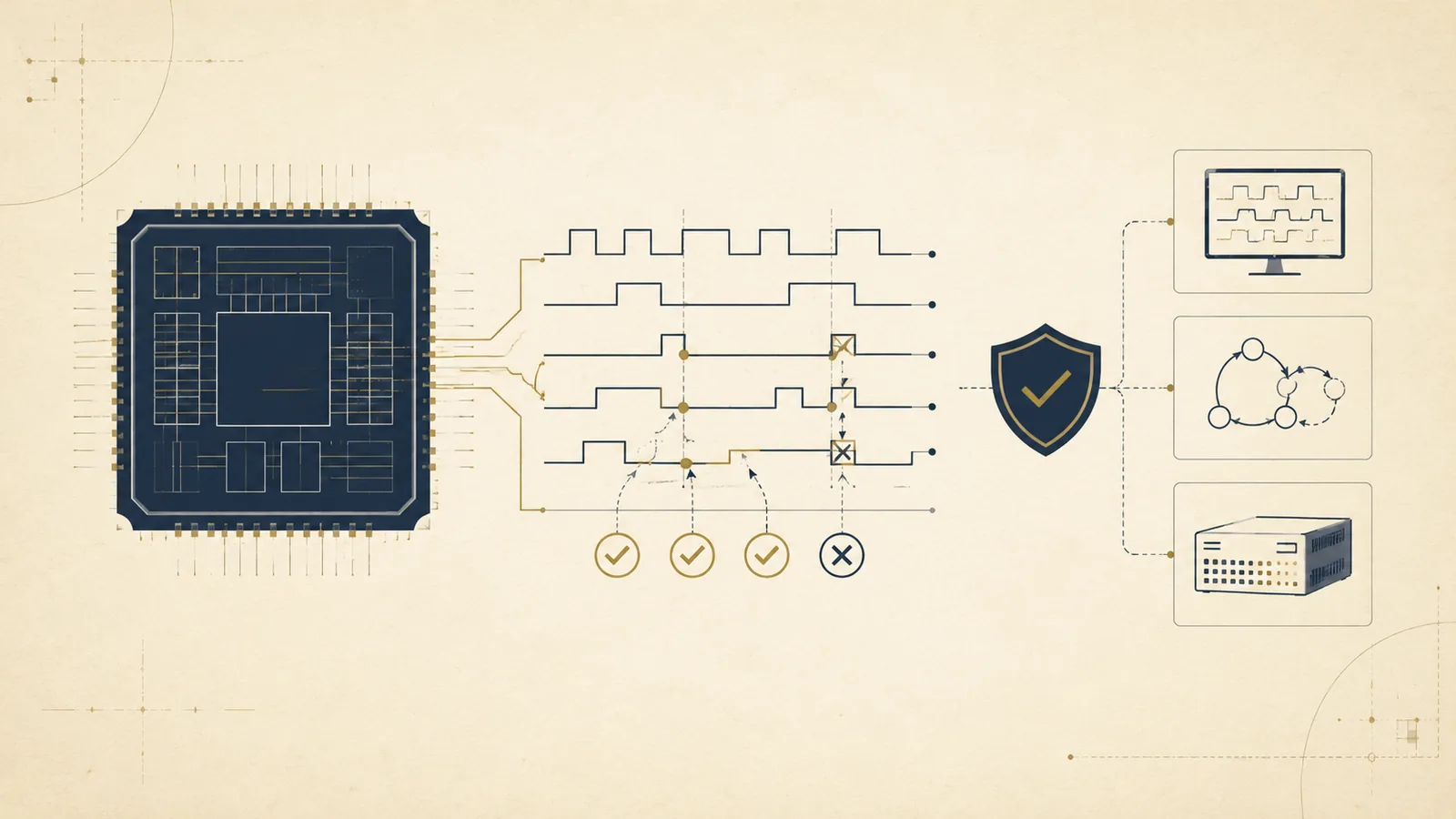

Introduction to Assertion Based Verification - PSL
Master ABV: Harness ABV methodology for formal, simulation, and emulation, applying PSL judiciously for optimal verification metrics!
This course provides a concise introduction to Assertion-Based Verification (ABV) using Property Specification Language (PSL). Learn to translate design specifications into executable assertions, improving verification quality. Explore PSL syntax, coding best practices, and strategies for effective property specification. Prepare to apply ABV methodologies in formal, simulation, and acceleration verification.
This course includes
courseWhat you'll learn
courseWho is this course for
courseRequirements
courseDescription
Assertion Based Verification provides an effective way to improve quality of verification by providing better controllability and observability of design errors. ABV is enabled with specification of assertions in the design. Assertions are executable specification of the design and are mostly written as 'assert' properties used to check the design functionality and 'cover' properties primarily used for functional coverage. Assertion can be verified using different ABV technologies: Formal, Simulation and Emulation/Acceleration. ABV is a form of whitebox testing. That is, properties—asserted behaviors—can monitor behavior deep within the design and not just at the interfaces. This feature lets you identify errors sooner and closer to the source, and also lets you specify functional coverage points deep within the design. The following are the primary technologies that use assertions: First, Simulation, Dynamic checking of monitors in simulation. Second, Formal Analysis, Static property checking tools are used to prove that a property that is asserted will hold true for all input conditions that do not violate an assumed behavior. Third, Emulation/Acceleration, Another form of dyn...
This course includes
courseWhat you'll learn
courseWho is this course for
courseRequirements
courseDescription
Assertion Based Verification provides an effective way to improve quality of verification by providing better controllability and observability of design errors. ABV is enabled with specification of assertions in the design. Assertions are executable specification of the design and are mostly written as 'assert' properties used to check the design functionality and 'cover' properties primarily used for functional coverage. Assertion can be verified using different ABV technologies: Formal, Simulation and Emulation/Acceleration. ABV is a form of whitebox testing. That is, properties—asserted behaviors—can monitor behavior deep within the design and not just at the interfaces. This feature lets you identify errors sooner and closer to the source, and also lets you specify functional coverage points deep within the design. The following are the primary technologies that use assertions: First, Simulation, Dynamic checking of monitors in simulation. Second, Formal Analysis, Static property checking tools are used to prove that a property that is asserted will hold true for all input conditions that do not violate an assumed behavior. Third, Emulation/Acceleration, Another form of dyn...
Recommended

EDA Academy is a practical learning platform for engineers in the VLSI and semiconductor industry. We offer structured courses, technical resources, and career-focused training across all major areas of chip design and verification — from Verilog to Physical Design, from fundamentals to advanced topics. Learn at your own pace, explore member-exclusive content, or join as an instructor to share your expertise. Lear...
