


AI Hardware Computing Requirements and Applications
Artificial intelligence is reshaping work, applications, and computing platforms. This overview explains AI, machine learning, deep learning, deployment examples, CPU/GPU trade-offs, edge AI constraints, inference performance, neural processors, and custom AI chip requirements for modern intelligent systems.
This resource includes
Description
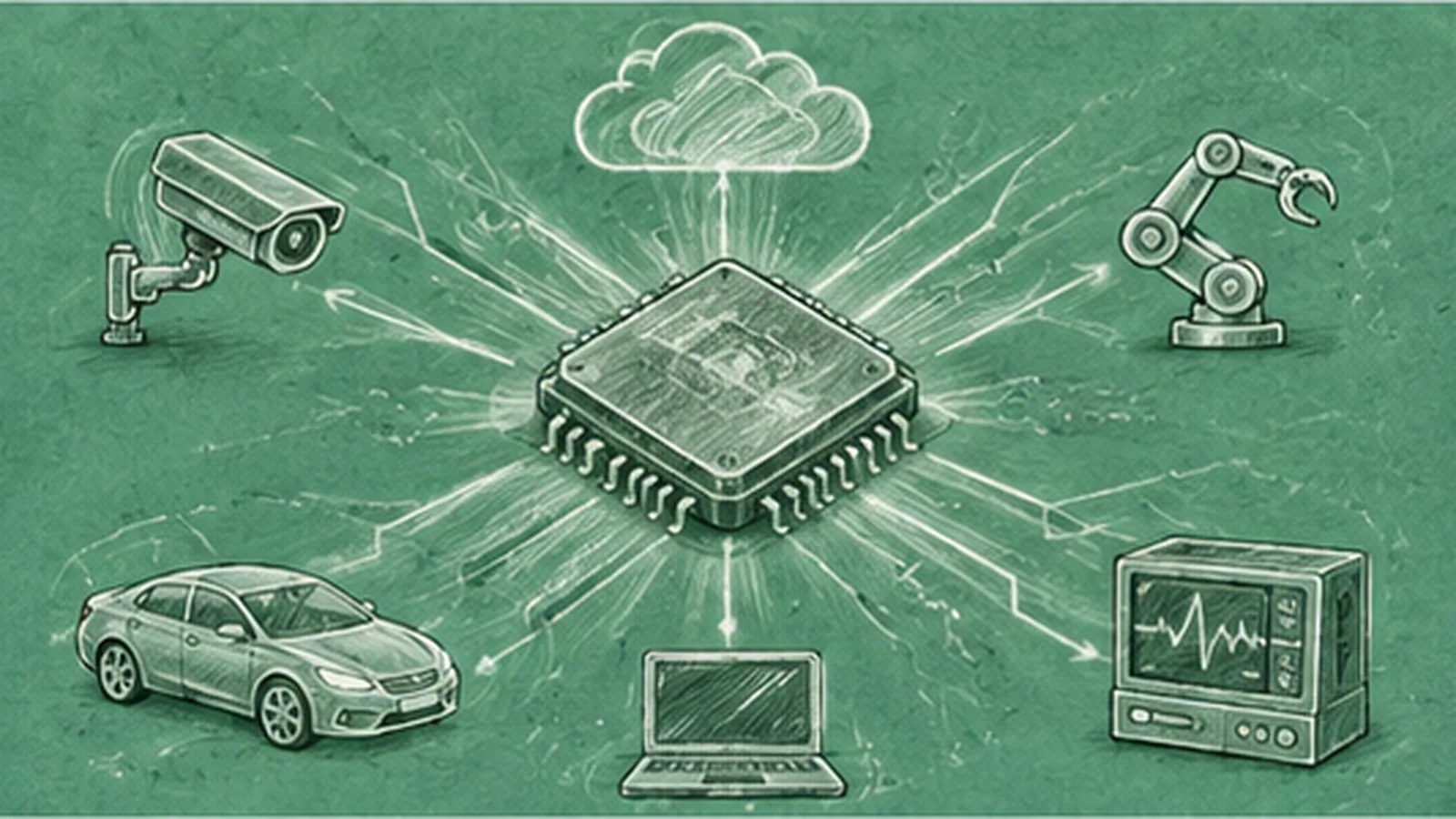
Artificial intelligence depends on more than algorithms. Real AI systems require suitable computing platforms, balanced hardware resources, efficient memory access, and acceleration structures that match the workload. Modern machine learning applications range from text and code generation to computer vision, disease detection, chip manufacturing, self-driving systems, and automotive object recognition. Each application creates different requirements for latency, throughput, precision, power, storage, and deployment environment. AI, machine learning, and deep learning define different levels of intelligent computation. Machine learning uses data to build models, while deep learning uses layered neural networks to process complex patterns in images, language, signals, and sensor data. These models place heavy demands on compute hardware. Small inference workloads may run on multi-core CPUs, while deep learning training and high-throughput inference often require GPUs, DSPs, neural processing units, tensor processing units, or dedicated AI processor IP. Hardware selection requires clear understanding of CPU and GPU architecture trade-offs. CPUs provide low latency, flexible control...
This resource includes
Description
Artificial intelligence depends on more than algorithms. Real AI systems require suitable computing platforms, balanced hardware resources, efficient memory access, and acceleration structures that match the workload. Modern machine learning applications range from text and code generation to computer vision, disease detection, chip manufacturing, self-driving systems, and automotive object recognition. Each application creates different requirements for latency, throughput, precision, power, storage, and deployment environment. AI, machine learning, and deep learning define different levels of intelligent computation. Machine learning uses data to build models, while deep learning uses layered neural networks to process complex patterns in images, language, signals, and sensor data. These models place heavy demands on compute hardware. Small inference workloads may run on multi-core CPUs, while deep learning training and high-throughput inference often require GPUs, DSPs, neural processing units, tensor processing units, or dedicated AI processor IP. Hardware selection requires clear understanding of CPU and GPU architecture trade-offs. CPUs provide low latency, flexible control...
Recommended

EDA Academy is a practical learning platform for engineers in the VLSI and semiconductor industry. We offer structured courses, technical resources, and career-focused training across all major areas of chip design and verification — from Verilog to Physical Design, from fundamentals to advanced topics. Learn at your own pace, explore member-exclusive content, or join as an instructor to share your expertise. Lear...
