

.png&w=3840&q=75)
Introduction to Static Timing Analysis
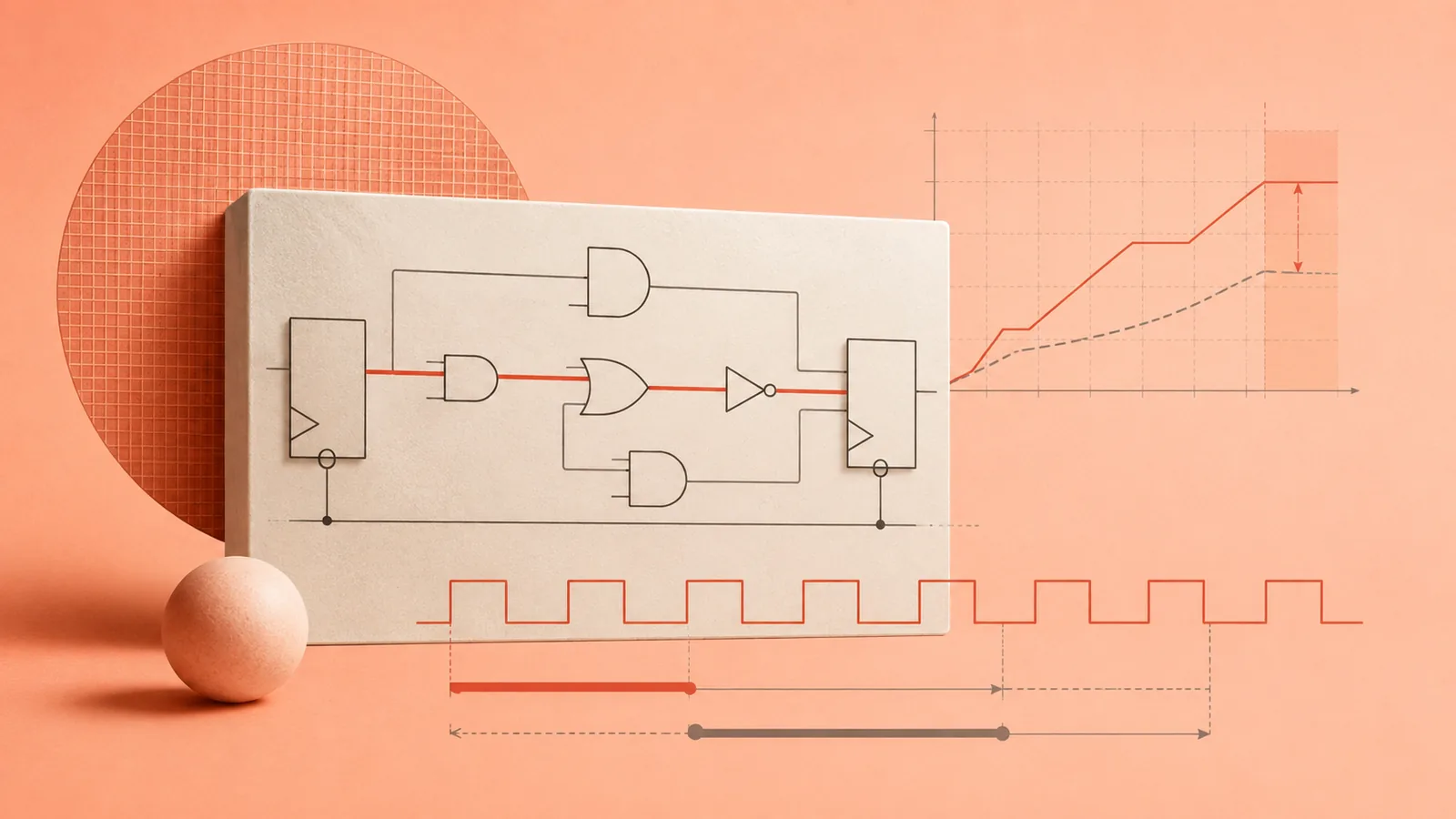
Static Timing Analysis (STA) is a deterministic method used to verify the timing behavior of digital circuits without requiring simulation or stimulus patterns. It decomposes the design into timing paths and evaluates signal transitions across cells and interconnects using timing libraries. By calculating cell delays, net delays, and slew effects, STA ensures that all timing constraints—such as setup and hold—are satisfied. This methodology is crucial for maintaining design integrity under varying conditions, supporting reliable operation at target frequencies, and enabling successful tape-out in complex SoC environments.
This resource includes
resourceDescription
Static Timing Analysis (STA) plays a central role in digital design validation by evaluating the timing integrity of signal transitions without relying on input vectors or functional simulation. It operates purely on the structural and timing models of the circuit, offering a fast and exhaustive alternative to simulation-based verification. By analyzing all logical paths between data launch and capture points, STA determines whether each transition satisfies the design’s timing constraints. This includes both setup and hold checks, across all relevant clocking conditions and process-voltage-temperature corners. Timing paths are the fundamental building blocks of STA. Each path consists of a series of timing arcs, which model the propagation of signals between the pins of logic cells and through the interconnect network. Timing arcs characterize the delay and transition behavior between input and output pins, incorporating properties such as directionality, unateness, and dependency on slew and load. These properties determine how delays vary with input transitions and output capacitance, allowing for precise timing estimation. For instance, unateness describes whether the output...
This resource includes
resourceDescription
Static Timing Analysis (STA) plays a central role in digital design validation by evaluating the timing integrity of signal transitions without relying on input vectors or functional simulation. It operates purely on the structural and timing models of the circuit, offering a fast and exhaustive alternative to simulation-based verification. By analyzing all logical paths between data launch and capture points, STA determines whether each transition satisfies the design’s timing constraints. This includes both setup and hold checks, across all relevant clocking conditions and process-voltage-temperature corners. Timing paths are the fundamental building blocks of STA. Each path consists of a series of timing arcs, which model the propagation of signals between the pins of logic cells and through the interconnect network. Timing arcs characterize the delay and transition behavior between input and output pins, incorporating properties such as directionality, unateness, and dependency on slew and load. These properties determine how delays vary with input transitions and output capacitance, allowing for precise timing estimation. For instance, unateness describes whether the output...
Recommended

EDA Academy is a practical learning platform for engineers in the VLSI and semiconductor industry. We offer structured courses, technical resources, and career-focused training across all major areas of chip design and verification — from Verilog to Physical Design, from fundamentals to advanced topics. Learn at your own pace, explore member-exclusive content, or join as an instructor to share your expertise. Lear...
