


Fundamentals of Manufacturing Test and Fault Modeling
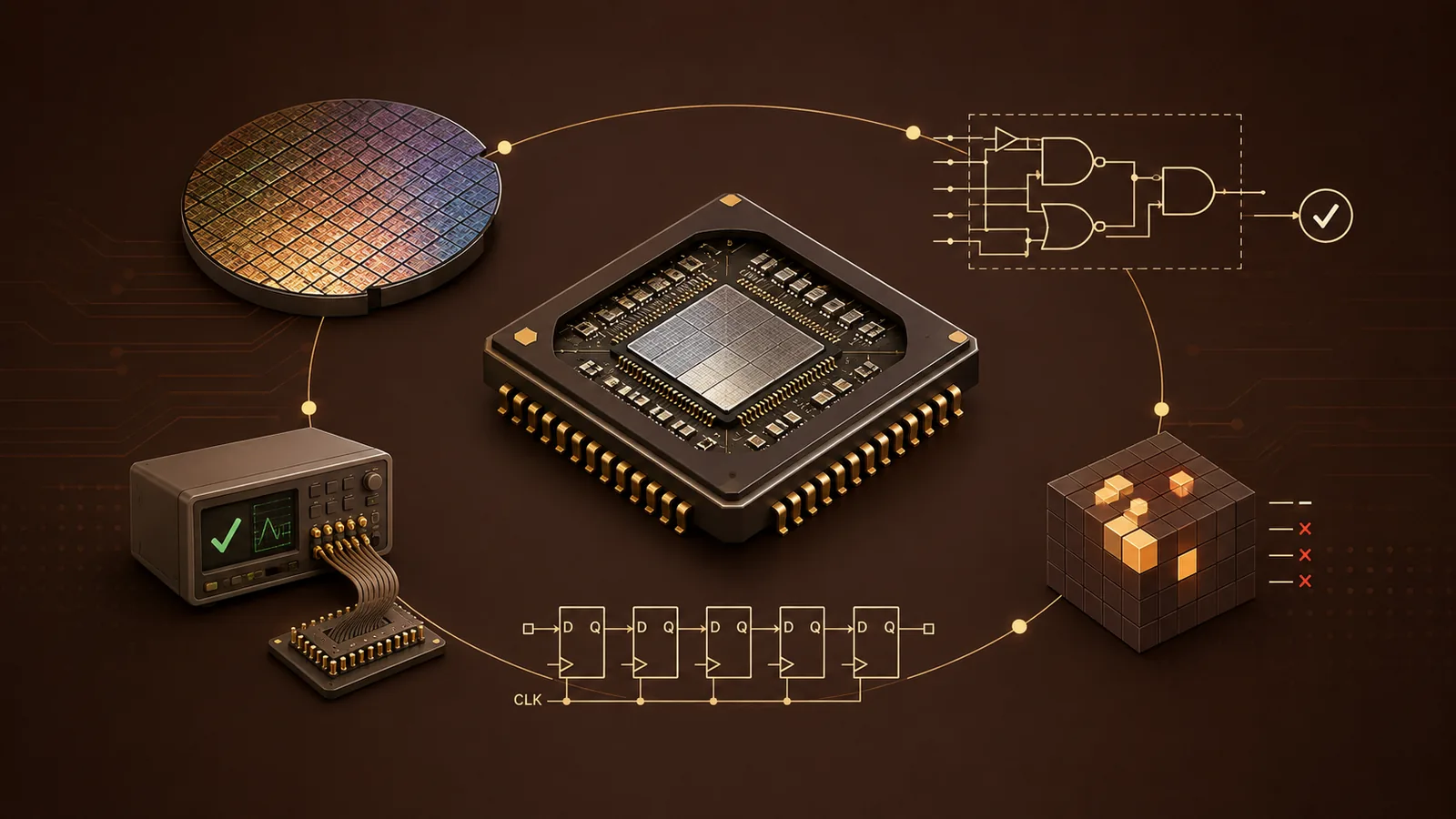
Foundation in IC manufacturing test, covering design abstraction, silicon defects, fault models, control, observation, functional testing, and structural testing. The focus is on how manufactured chips are evaluated against gate-level intent under practical production constraints.
This resource includes
Description
Integrated circuit testing connects abstract chip design with physical silicon behavior. A chip may pass extensive functional verification before fabrication, but manufacturing introduces physical imperfections that cannot be eliminated by design verification alone. Defects such as opens, shorts, resistive interconnects, contamination, and process variation can cause the fabricated device to deviate from its intended gate-level implementation. Manufacturing test provides the mechanism for identifying these deviations before defective devices reach customers. The technical foundation begins with the design abstraction flow. Functional intent is refined into RTL, gate-level logic, and physical layout, with verification applied throughout the process to preserve correctness. Once the gate-level design is fixed, the functional behavior is already defined. Manufacturing test does not validate whether the original design is correct; it checks whether the silicon accurately implements that design. This distinction separates design verification from production test and clarifies why passing test means “built as designed,” not necessarily “designed correctly.” Physical manufacturing defec...
This resource includes
Description
Integrated circuit testing connects abstract chip design with physical silicon behavior. A chip may pass extensive functional verification before fabrication, but manufacturing introduces physical imperfections that cannot be eliminated by design verification alone. Defects such as opens, shorts, resistive interconnects, contamination, and process variation can cause the fabricated device to deviate from its intended gate-level implementation. Manufacturing test provides the mechanism for identifying these deviations before defective devices reach customers. The technical foundation begins with the design abstraction flow. Functional intent is refined into RTL, gate-level logic, and physical layout, with verification applied throughout the process to preserve correctness. Once the gate-level design is fixed, the functional behavior is already defined. Manufacturing test does not validate whether the original design is correct; it checks whether the silicon accurately implements that design. This distinction separates design verification from production test and clarifies why passing test means “built as designed,” not necessarily “designed correctly.” Physical manufacturing defec...
Recommended

EDA Academy is a practical learning platform for engineers in the VLSI and semiconductor industry. We offer structured courses, technical resources, and career-focused training across all major areas of chip design and verification — from Verilog to Physical Design, from fundamentals to advanced topics. Learn at your own pace, explore member-exclusive content, or join as an instructor to share your expertise. Lear...
