

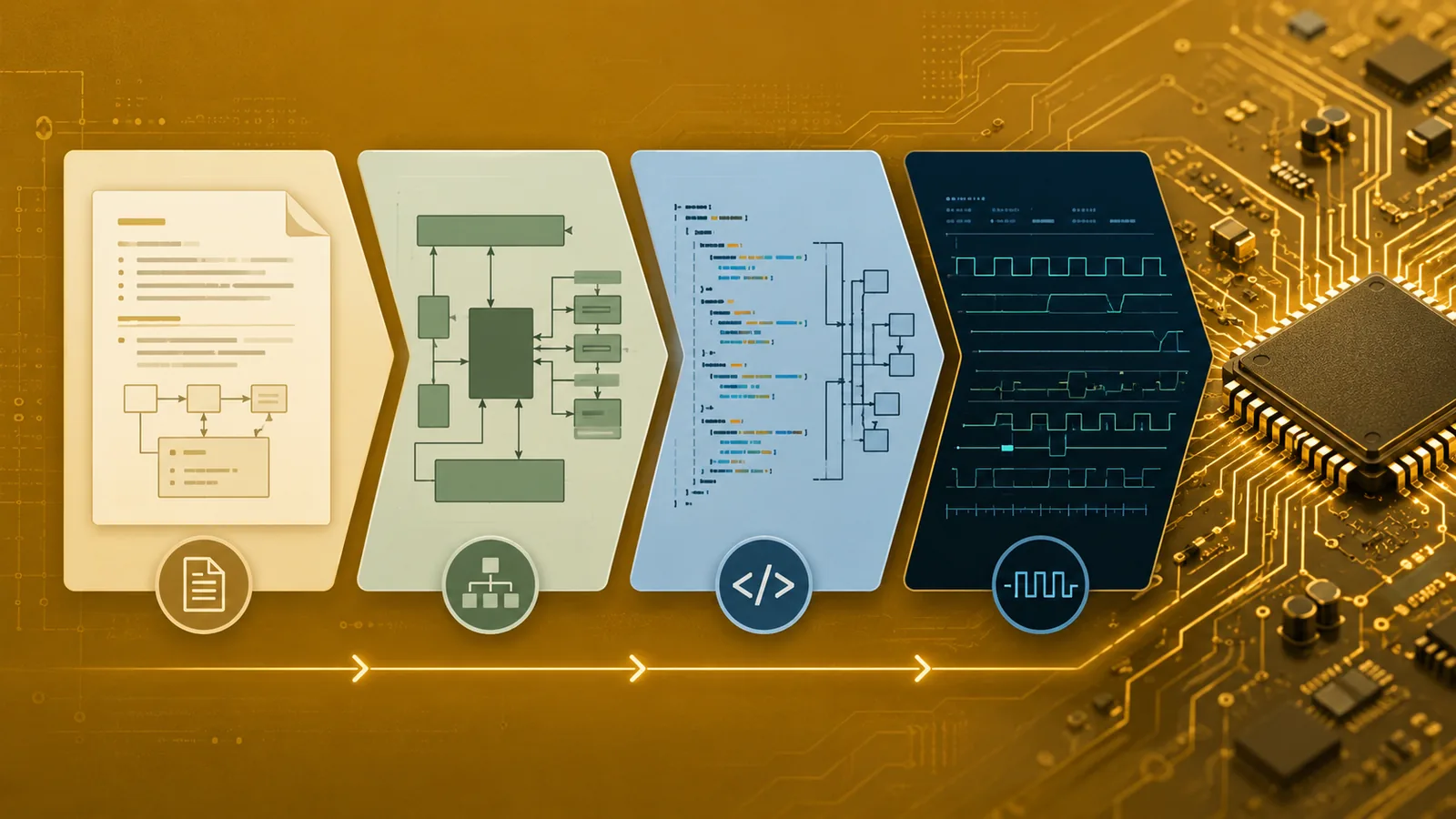

From Specification to RTL with HDL Abstractions
Digital IC design moves from specification to microarchitecture, then to RTL and HDL-based simulation. Clear abstraction levels help express design intent, define implementation choices, manage tradeoffs, verify behavior, and connect high-level requirements with final digital hardware.
This resource includes
Description
Digital IC design starts with a specification that captures required behavior, interfaces, performance targets, and system constraints. The specification acts as the reference model for chip planning, IP selection, new logic definition, functional partitioning, and communication across design groups. It also records important system-level decisions, such as external memory selection and operating frequency, where one choice can affect chip I/Os, board routing, clock inputs, software behavior, and performance expectations. Microarchitecture refines the specification into block-level structure. A major block from the specification becomes a set of smaller internal blocks, with defined datapaths, control logic, storage structures, interfaces, buses, and protocols. This level introduces implementation tradeoffs while keeping the required external behavior stable. Choices such as internal SRAM versus register arrays, multiple datapaths versus a single datapath, and area versus performance are evaluated inside the block boundary. RTL gives the microarchitecture a coded hardware form. Register Transfer Level modeling describes signal movement between registers and the operations perform...
This resource includes
Description
Digital IC design starts with a specification that captures required behavior, interfaces, performance targets, and system constraints. The specification acts as the reference model for chip planning, IP selection, new logic definition, functional partitioning, and communication across design groups. It also records important system-level decisions, such as external memory selection and operating frequency, where one choice can affect chip I/Os, board routing, clock inputs, software behavior, and performance expectations. Microarchitecture refines the specification into block-level structure. A major block from the specification becomes a set of smaller internal blocks, with defined datapaths, control logic, storage structures, interfaces, buses, and protocols. This level introduces implementation tradeoffs while keeping the required external behavior stable. Choices such as internal SRAM versus register arrays, multiple datapaths versus a single datapath, and area versus performance are evaluated inside the block boundary. RTL gives the microarchitecture a coded hardware form. Register Transfer Level modeling describes signal movement between registers and the operations perform...
Recommended

EDA Academy is a practical learning platform for engineers in the VLSI and semiconductor industry. We offer structured courses, technical resources, and career-focused training across all major areas of chip design and verification — from Verilog to Physical Design, from fundamentals to advanced topics. Learn at your own pace, explore member-exclusive content, or join as an instructor to share your expertise. Lear...
