

_Overview%2B(EN).png&w=3840&q=75)
Clock Domain Crossing (CDC) Overview
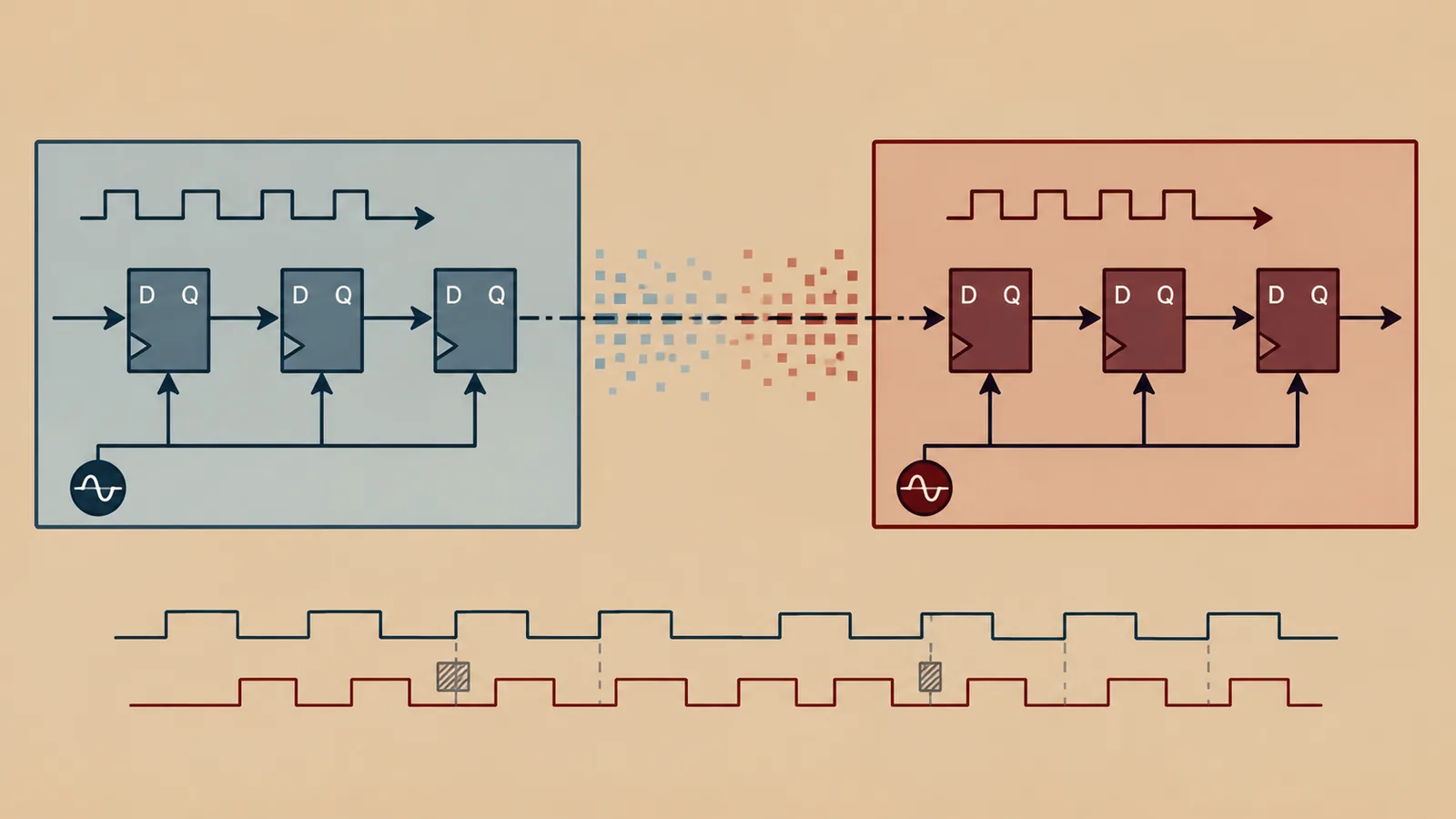
Clock domain crossing (CDC) introduces complex challenges in digital design, where asynchronous clock boundaries can result in metastability, timing violations, and data integrity risks. Key issues include glitch propagation, multi-fanout inconsistencies, and improper synchronization. Understanding metastability fundamentals, modeling techniques, and structural and functional hazards is critical. This includes signal divergence, instability from data transitions, and encoding errors like improper use of Gray code. Effective CDC handling requires robust synchronization schemes—such as NDFF, MUX, handshake, FIFO, pulse, and edge synchronizers—combined with quantitative reliability analysis like Mean Time Between Failure (MTBF) to ensure functional correctness across asynchronous domains.
This resource includes
resourceDescription
Clock domain crossing arises when signals are transferred between functional blocks operating under independent clock sources. The lack of temporal correlation between these domains introduces significant risk of metastability, where a flip-flop may enter an indeterminate voltage state if its setup or hold requirements are violated. This metastable state can propagate incorrect values downstream and cause unpredictable functional behavior. Understanding the timing violation mechanisms and the probability of occurrence under varying clock frequencies and signal transitions is essential for mitigating these risks at the architectural level. Fundamentals of metastability must be carefully modeled and quantified. Circuit behavior during metastable resolution is characterized by time-dependent exponential decay, requiring statistical analysis to determine Mean Time Between Failure (MTBF). Modeling techniques consider metastability window width, clock frequency, flip-flop characteristics, and propagation depth. MTBF estimation provides a measurable target for evaluating synchronizer effectiveness under worst-case operating conditions. Signal divergence, where metastable signals fan ou...
This resource includes
resourceDescription
Clock domain crossing arises when signals are transferred between functional blocks operating under independent clock sources. The lack of temporal correlation between these domains introduces significant risk of metastability, where a flip-flop may enter an indeterminate voltage state if its setup or hold requirements are violated. This metastable state can propagate incorrect values downstream and cause unpredictable functional behavior. Understanding the timing violation mechanisms and the probability of occurrence under varying clock frequencies and signal transitions is essential for mitigating these risks at the architectural level. Fundamentals of metastability must be carefully modeled and quantified. Circuit behavior during metastable resolution is characterized by time-dependent exponential decay, requiring statistical analysis to determine Mean Time Between Failure (MTBF). Modeling techniques consider metastability window width, clock frequency, flip-flop characteristics, and propagation depth. MTBF estimation provides a measurable target for evaluating synchronizer effectiveness under worst-case operating conditions. Signal divergence, where metastable signals fan ou...
Recommended

EDA Academy is a practical learning platform for engineers in the VLSI and semiconductor industry. We offer structured courses, technical resources, and career-focused training across all major areas of chip design and verification — from Verilog to Physical Design, from fundamentals to advanced topics. Learn at your own pace, explore member-exclusive content, or join as an instructor to share your expertise. Lear...
