

Computer I/O Systems and Interface Architecture

Computer I/O Systems and Interface Architecture

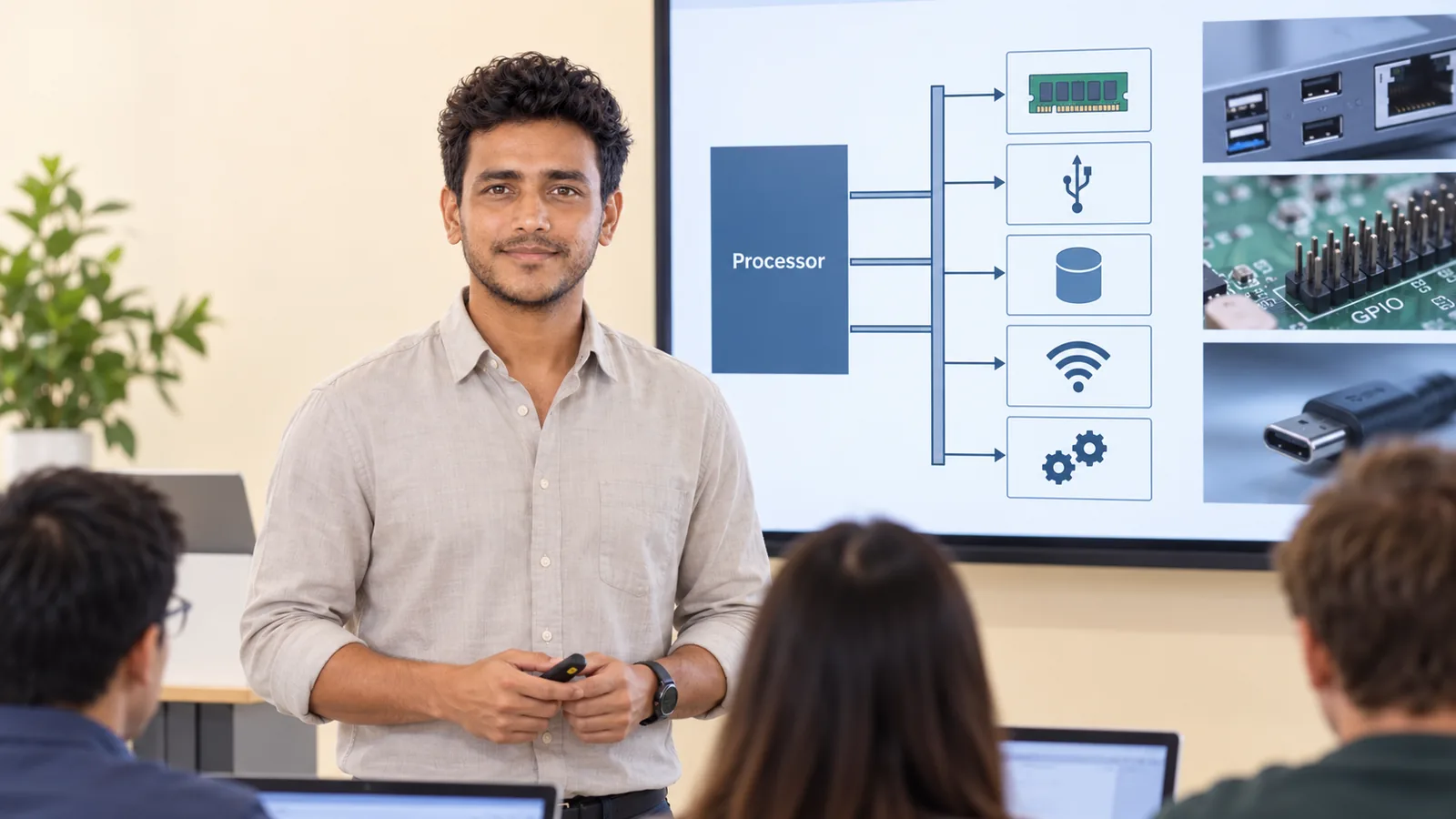
Computer I/O connects processors with memory, peripherals, physical devices, and networks through memory-mapped registers, device drivers, GPIO, serial and analog interfaces, timers, buses, and high-speed standards including USB, PCI Express, Ethernet, DDR3, and SATA.
Created by Amit Joshi
Last update 09/2026
Level Advanced
Language English
5.0
(0)
0
students

This offering includes

  • 1 module
  • 8 lectures
  • Access on mobile and computer
  • 2.16 hours on-demand video

Description

Computer I/O architecture defines how processors exchange information with memory, peripherals, communication devices, and physical hardware. Memory-mapped I/O provides a common programming model in which peripheral registers occupy processor address space and can be accessed through normal load and store operations. Address decoding selects the appropriate device, while device drivers hide register addresses, bit fields, timing requirements, and hardware-specific behavior behind structured software interfaces. GPIO extends this model to configurable digital pins, with registers controlling direction, input state, output values, alternate functions, and interrupt conditions. Embedded systems combine digital I/O with serial communication, timing, and analog conversion. SPI, UART, and I2C transfer data through compact serial connections, while Bluetooth modules can replace wired serial links with low-power wireless communication. Timers use free-running counters and compare channels to measure or generate precise time intervals, while interrupt-driven processing avoids the inefficiency of continuous polling. ADCs convert continuous analog voltages into digital samples, DACs perform ...

You may also want to learn

Explore more
Amit Joshi
Amit Joshi
Individual
IP Design Engineer
Average
5.0
Ratings
0
Students
0
Offerings
11 live

Bio

Accomplished IP Design Engineer with more than 18 years of semiconductor experience across reusable IP architecture, RTL implementation, verification, timing closure, DFT, and PPA optimization. Proven record of leading complex IP programs for mixed-signal ICs, processor cores, and high-performance SoCs. Combines hands-on engineering depth with technical leadership, stakeholder engagement, and disciplined cross-functional delivery.

Secure checkout via our payment partner.